Scite vs Crossref for Checking Research Citations
Use Crossref to investigate reference identity and Scite to inspect citation context. Keep both checks separate from whether a paper supports your exact claim.
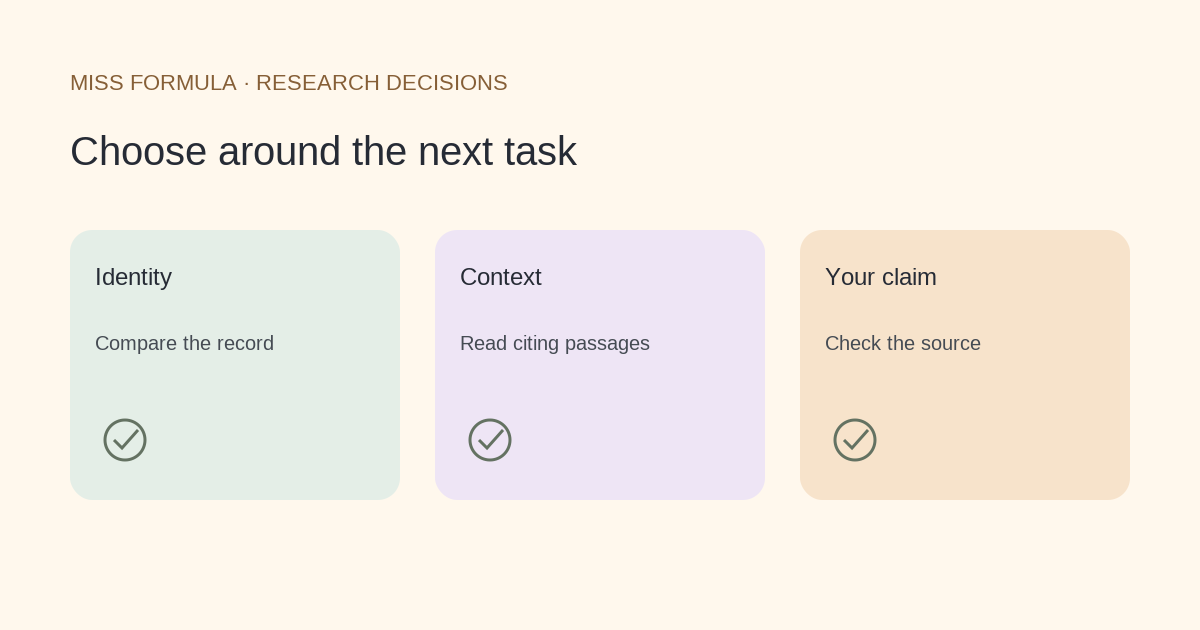
They answer different citation questions
Start with Crossref when you need to identify a work or reconcile a DOI with a reference. Use Scite when your question is how other indexed papers discuss that work. Then read the original paper to decide whether it supports your own sentence. These are complementary checks, so there is no useful single winner for every citation problem.
| Question | Crossref | Scite |
|---|---|---|
| Which work is this? | Metadata and DOI lookup are the starting role | Identify the exact work before reading its report |
| How do other papers cite it? | Metadata retrieval is not a citation-statement classification service | Smart Citations classify indexed citation statements as supporting, contrasting or mentioning |
| Does it support my sentence? | A matching record cannot answer this | A citation classification still requires reading the relevant passages |
| Main limitation to retain | Deposited metadata may be incomplete or differ from the typed reference | Context depends on available indexed citing material and classification |
| Practical handoff | Save the verified record and unresolved fields | Save the relevant citing passage and your interpretation |
This comparison uses Crossref’s metadata documentation and Scite’s feature descriptions; it is not a coverage or accuracy benchmark.
Check identity before evaluating context
A plausible title and a resolving DOI can still belong to different works. Copy the DOI from the draft, open its record, and compare the title, authors, year and venue. Distinguish a harmless punctuation difference from a change that identifies another work. A preprint and a later journal article also need deliberate handling rather than an automatic merge.
Crossref’s Simple Text Query documentation describes reference-to-DOI matching. Treat returned candidates as candidates: examine the complete reference. A failure to find a record is unresolved evidence, not proof that a work is fabricated. Some works use different registration agencies, and some references lack a DOI. See the no-DOI reference workflow.
Use citation context for the next question
Scite describes Smart Citations and reports that expose citing statements and their classifications. That is useful when you want to investigate how later literature discusses a result. A contrasting statement is a reason to read carefully, while a supporting statement is still tied to a particular question and context.
Do not turn a category count into a verdict on your manuscript. Read enough surrounding text to identify the population, intervention, outcome and qualification relevant to your sentence. A paper can be cited for a method in one place and a finding in another. Nor does the absence of a visible contrasting citation establish universal agreement.
Keep three decisions in a citation audit
Here is a fictional audit row: a draft says “Method X improves outcome Y in all adults” and cites a small study of one clinical subgroup. The study may be real and its DOI correct, while the sentence remains broader than the evidence. No real paper or result is implied by this example.
| Decision | Evidence to retain | Next action |
|---|---|---|
| Identity | Record URL, DOI and compared fields | Correct the bibliography or keep an unresolved flag |
| Citation context | Relevant citing statement and its source | Read the discussion and note what it actually addresses |
| Claim support | Passage, study group, outcome and limitations in the cited paper | Narrow the sentence or find a more suitable source |
This worksheet keeps a polished bibliography from hiding an unsupported generalization. It also prevents a correct citation from being discarded solely because a lookup was incomplete. For correction or retraction status, separately inspect the publisher and update-record workflow.
Where Miss Formula fits
Miss Formula AI Citation Checker compares bibliographic fields against scholarly records. It is relevant to the identity row, with traceable matches and reasons; it is not a replacement for Scite’s citation-context analysis or reading the original paper. A batch is billed per reference, not as one reference-checking operation.
Follow the metadata-mismatch guide when a field differs. When your sentence needs a new source rather than a corrected record, use AI Source Finder and inspect the candidate evidence. The Crossref-versus-Google-Scholar comparison covers lookup choice, a different decision from citation-context review.
Questions about citation checks
Does a valid DOI prove a claim? No; it helps identify an object. Does “supporting” mean my exact sentence is supported? No; examine the classified statement and the cited study. Does no match mean fake? No; investigate other authoritative sources and incomplete input. Can these checks be combined? Yes; keep identity, context and claim-support evidence in separate audit fields.
Sources checked November 26, 2026: Crossref metadata retrieval, Simple Text Query and Scite features. Coverage totals and paywalled-access claims are not reproduced.