How to Paraphrase Research Findings Without Changing Their Meaning
Use a meaning checklist and a before-and-after example to preserve population, comparisons, uncertainty, and attribution when revising.
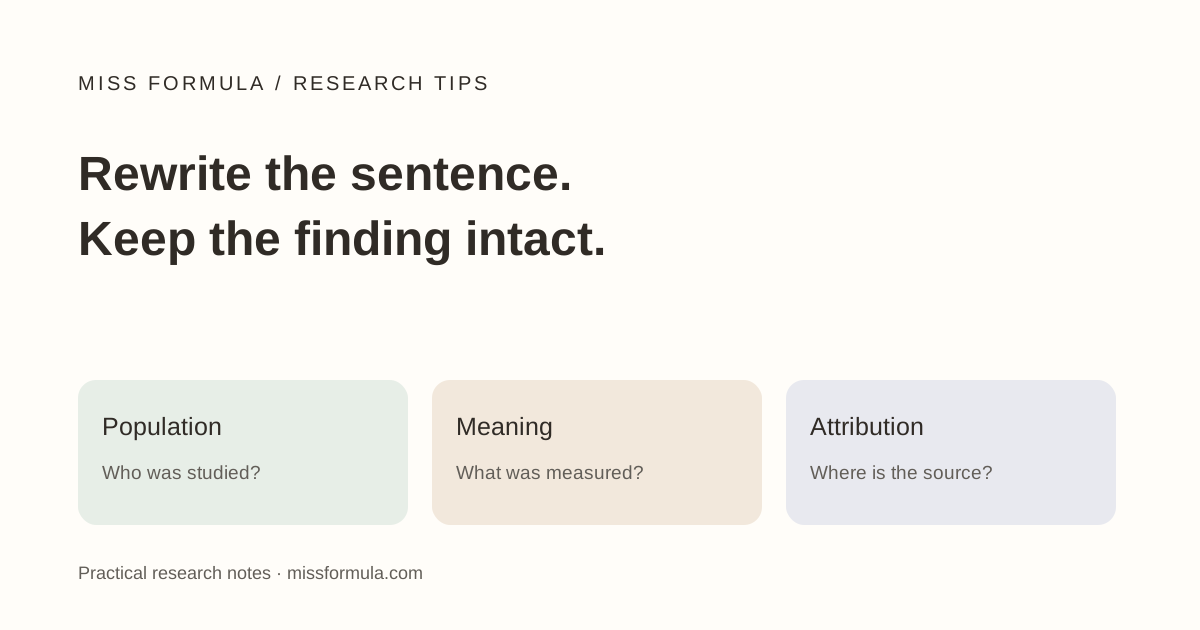
Write down what the finding commits you to
Before rewriting a research finding, record the population, design, comparison, outcome, timing and uncertainty. Then draft a new sentence from those notes, reopen the source and compare the meaning. Keep the citation attached to the idea throughout revision.
A polished sentence can still be inaccurate. “Was associated with” can become “caused,” a four-week measure can become a permanent benefit, and a small sample can become “all students.” These are changes to the claim, even when the replacement words sound natural.
Compare three versions of one invented result
Teaching example: the study, sample and values below are invented. Source note: “In an observational sample of 80 graduate students, self-reported weekly planning was associated with lower stress scores at the four-week survey. Baseline differences may explain the association.” This is not a published result and must not be cited as evidence.
| Version | Sentence | Assessment |
|---|---|---|
| Cosmetic change | In an observational group of 80 graduate students, reported weekly planning was linked to reduced stress scores at four weeks. | Closely follows the original structure and drops the caveat. |
| Meaning changed | Weekly planning reduces stress for students. | Adds causality and generalizes beyond the sample and time point. |
| More faithful revision | At a four-week survey, graduate students who reported planning weekly also reported lower stress; the observational comparison of 80 participants could reflect baseline differences. | Preserves the observed association, timing, sample and limitation; a real use would cite the actual source. |
The third version is a possible revision of this teaching text, not the only acceptable phrasing. In real work, preserve the source’s exact variable names when a looser synonym would change the measurement. Technical terms do not have to be replaced merely to look different.
Change the sentence structure and retain attribution
The Office of Research Integrity’s paraphrasing guidance distinguishes substantial restatement from cosmetic substitutions and says that both paraphrases and summaries need credit. Its ethical-writing guidelines also emphasize retaining the meaning of the original ideas and facts.
- Read the relevant result and its qualification, not only the abstract’s conclusion.
- Set the wording aside and explain the finding from your meaning notes.
- Reopen the source and check every factual element.
- Add the correct citation where the borrowed idea enters your paragraph.
- Quote distinctive wording when you need the exact expression, following the required citation style.
If the source supports only part of your sentence, split the sentence. A citation at the end should not silently appear to support a second, unsupported assertion.
Use a meaning checklist after an AI rewrite
| Check | Question to ask |
|---|---|
| Population | Did the rewrite broaden a specific sample into a larger population? |
| Design and causality | Did an association become an intervention effect? |
| Comparator | Did “compared with rereading” disappear? |
| Outcome and timing | Did a measured score become general wellbeing, learning or a lasting benefit? |
| Uncertainty | Were qualifications, intervals or alternative explanations removed? |
| Attribution | Does the citation still attach to the right idea? |
A useful editing instruction is: “Improve clarity while preserving the sample, study design, comparator, outcome, time point, uncertainty and citations. Flag ambiguity instead of filling missing information.” This is a reusable instruction, not a claim about a guaranteed model response.
If you use Miss Formula AI Writer to revise a passage, inspect the revision against these notes and your original source. An automated rewrite is a draft to assess; fluency does not demonstrate fidelity.
Check attribution and text matching separately
A text-match report answers a different question from a meaning review. Review matched passages for attribution or quotation issues, and compare the factual statement with the paper itself. A low match percentage does not establish that the rewrite accurately represents the research.
For a source you already have, the uploaded-reference comparison workflow can help you inspect overlapping wording. It does not replace checking methods and results. Finish by asking: could a reader open my cited source and find the precise claim I wrote?
Sources and product interfaces checked November 19, 2026. Examples are teaching material unless a published source is identified.
Continue in Miss Formula
Use the relevant tool, then inspect the sources and output before relying on them.