How to Build a Literature Review Evidence Matrix
Move from a stack of paper summaries to a source-linked comparison table, with a worked example and a reusable matrix template.
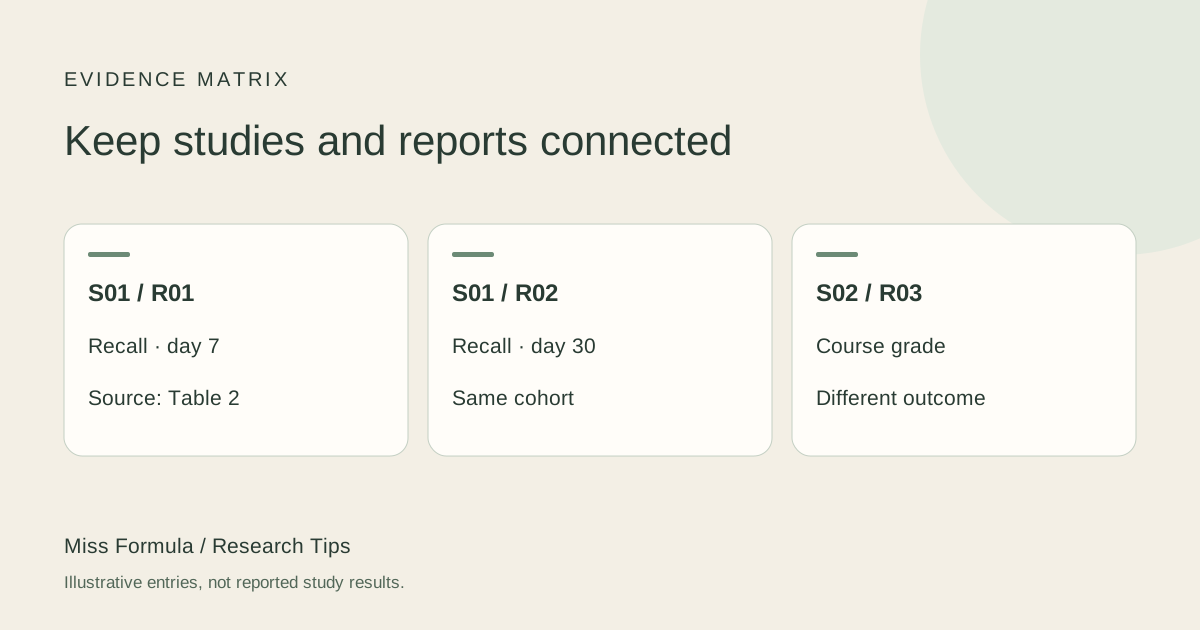
Build the matrix around a decision
A useful evidence matrix lets you compare studies without reopening every PDF. Start with the question your review must answer, then record the population, design, comparison, outcome, time point, result, and source location. Add one column for what the evidence cannot establish. Keep your interpretation separate from the authors’ reported findings.
For example, “Do practice tests help students retain material after a week?” needs different fields from “Do students prefer quizzes?” Both involve testing, but they require different outcomes. Decide what a row means before filling it. For a small narrative review, one row per study–outcome–time-point combination is a practical starting point.
This is an organizing aid for reading and synthesis. A formal systematic review also needs its protocol, reproducible search, screening, appraisal, and prespecified extraction process.
Choose fields you can trace back to a report
The Cochrane Handbook, Chapter 5 distinguishes a study from its reports, recommends recording where extracted information was found, and advises retaining reported data before later transformations. Apply those principles when building your own reading matrix.
| Field | What to enter | Why it earns its place |
|---|---|---|
| Study ID / report ID | S01 / R01; title or DOI | Link follow-up papers to the same underlying study. |
| Population and design | Who participated; randomized, observational, or other design | Keep unlike settings and comparisons visible. |
| Outcome / timing | The measured variable, instrument, and follow-up | Avoid treating immediate and delayed results as interchangeable. |
| Reported result / locator | Estimate, units, uncertainty as reported; page and table | Let a coauthor check the exact value. |
| Interpretation / limit | Your qualified takeaway; missing information | Separate what was reported from what you infer. |
Use an explicit marker such as “not reported” for an absent value. A blank cell can mean missing, not yet checked, or not applicable; those states should not silently collapse into one another.
Use a small example to expose a hidden duplication
Illustrative example; these are invented studies and values. Suppose your folder contains three reports. Two describe different follow-ups from the same cohort. A paper-per-row summary can make them look like three independent studies.
| Study / report | Outcome and timing | Reported result | Source / limit |
|---|---|---|---|
| S01 / R01 | Recall score, day 7 | Practice 14/20; reread 11/20 | Table 2, p. 4; illustrative means, uncertainty not supplied here. |
| S01 / R02 | Recall score, day 30 | Practice 10/20; reread 9/20 | Table 1, p. 3; same cohort as R01. |
| S02 / R03 | Course grade, term end | Difference not reported | Results, p. 6; outcome differs from passage recall. |
Keep the first two rows because the follow-up differs. Link them with S01 so you do not count their participants twice. The third row does not answer the week-later recall question. It can inform a separate discussion about course performance, subject to the report’s design and available results.
Download the blank tab-separated matrix. Open it in a spreadsheet application, preserve a raw-results column, and add any discipline-specific fields before extracting your first study.
Pilot the table before extracting every paper
- Try two contrasting reports. Pick one straightforward study and one with multiple outcomes. Revise ambiguous field definitions now.
- Extract literally first. Preserve units, denominators, time points, and uncertainty labels. Put any conversion in a separate column with its formula.
- Add a locator immediately. Use the report ID, printed page or PDF page, and table or figure number. Distinguish printed from viewer page numbering.
- Record a decision. When reports disagree, keep both values and document how you resolved the discrepancy.
- Verify important cells. Reopen the source next to the table. For formal reviews, follow the protocol for independent extraction and reconciliation.
A practical check is to ask someone else to locate one result using only your row. If they cannot find it, improve the locator before adding more rows.
Write across rows rather than paper by paper
Group rows by outcome, setting, or comparison. Then write what is similar, what differs, and what remains unmeasured. In the illustrative matrix, a defensible synthesis would distinguish delayed passage recall from course grades and identify the two S01 reports as related evidence.
Avoid “three papers prove testing works.” A more useful planning sentence is: “The reports address different outcomes and follow-ups; two share one cohort, so their findings must be interpreted together.” Add actual source-backed results when writing your real review.
Use AI Source Finder to find candidate papers, then fill the matrix from the reports you actually read. If a result will support a sentence, apply the claim-to-evidence check. The matrix makes gaps visible; it does not turn an unread source into verified evidence.
Source guidance checked November 18, 2026. Follow the current instructions of your target journal or review protocol.
AI Source Finder
Find candidate studies for your review. Verify results against your original sources.