Citely Alternatives for Checking AI-Generated References
Choose a replacement around reference identity, DOI matching or citation context, and keep unresolved entries visible until the source is verified.
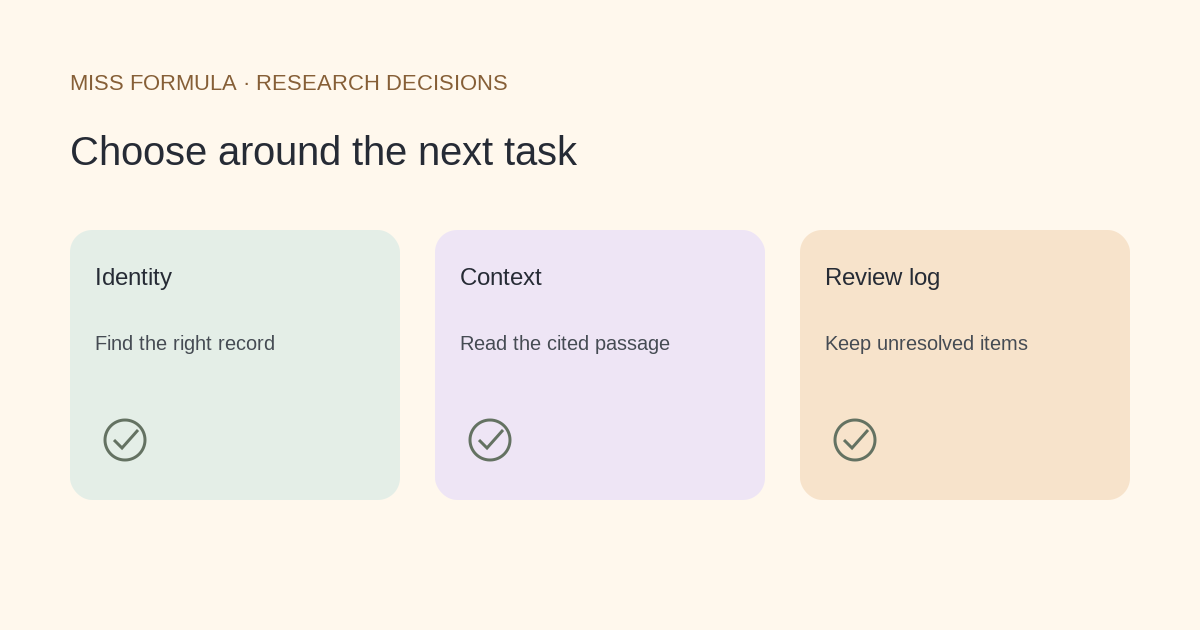
Replace the check you actually need
Use Miss Formula AI Citation Checker for a bibliography-to-record metadata check, Crossref Simple Text Query for DOI matching, or Scite when you need citation context and reference-quality signals. Keep Citely if its verification and export workflow already fits the job. These tools answer partly different questions, so a replacement should preserve the check you depend on.
| Option | Documented task | Boundary to retain |
|---|---|---|
| Citely | Check bibliographic entries against scholarly records | Open the original record before citing |
| Miss Formula | Compare reference identity and bibliographic fields | A match does not prove support for your sentence |
| Crossref Simple Text Query | Find possible DOI matches for pasted references | Ambiguous candidates require manual evaluation |
| Scite | Inspect citation context and manuscript reference signals | Citation classifications do not replace reading the relevant study |
This is a migration decision for an existing reference list. It is separate from finding sources for a paragraph or maintaining live citation fields in a reference manager.
When staying with Citely makes sense
Citely’s help center distinguishes source discovery from bibliography verification. It documents matching reference fields against scholarly records and advises opening the DOI or original record. That is a reasonable starting workflow for checking an AI-generated bibliography. A tool that returns a plausible candidate still needs a user decision about identity.
Its documented verification charging unit is character-based. Miss Formula charges per reference. Those are different units: do not compare credit counts as though one credit represented the same amount of work. Confirm the current plan and your actual reference length if cost is the reason to move. No lower-cost or higher-accuracy winner is established here.
Three routes for three gaps
Miss Formula’s AI Citation Checker compares title, authors, year, venue and DOI against connected scholarly records. It is useful for reviewing whether an identifier belongs to the entry you intended. It does not maintain a reference-manager library or determine whether a paper’s results support your claim. Check returned record links and retain unresolved entries.
Crossref Simple Text Query accepts references and looks for DOI matches. It can return multiple possible matches when the metadata is ambiguous. This is a focused option when DOI identity is the missing piece; it is not a complete reading or manuscript-evaluation service.
Scite documents citation statements, supporting/contrasting/mentioning classifications, and a Reference Check workflow for manuscript references. It can add context beyond bibliographic identity. Treat that context as material to inspect, rather than proof that the exact sentence you wrote is warranted. Check the needed feature’s current access conditions.
Carry an unresolved list through the switch
Before changing tools, save your original bibliography with stable row numbers. Use a copied list for checking. Keep a review log with the original entry, returned record URL, conflicting fields, decision and next action. A clean-looking export should never silently remove a reference the system could not resolve.
| Illustrative case | Decision to preserve |
|---|---|
| DOI resolves to a different title | Open the record; do not mark the intended citation confirmed |
| Title matches but year differs | Check online-first and issue dates before changing the year |
| Two plausible records | Compare authors, venue and version; leave unresolved if unclear |
| No result | Search the publisher or repository; absence alone is not proof of fabrication |
| Real paper, wrong claim | Review the full text and revise the claim or choose a suitable source |
These are fictional review cases, not observations of specific products. Try a small list with at least one known correct entry and one field conflict before moving a long bibliography. Compare the detected item count with your source list. If the unit of input changes from a line to an extracted reference, count reconciliation matters as much as the final status labels.
Start with a bounded verification pass
In Miss Formula, initial 10 credits plus the separately claimed 20-credit experience reward form a shared 30-credit pool. At one credit per reference, allocating that entire pool to Citation Checker covers 30 reference checks. Spending credits on other tools reduces what remains; a batch still charges by its reference count. This is not 30 free checks in addition to other uses of the same pool.
Use the mismatch-review instructions for returned fields and the no-DOI guide for incomplete entries. After identity checking, read the source passage relevant to the claim. Source discovery and authenticity checks are complementary steps, not interchangeable assurances.
Questions before replacing a checker
Does “not found” mean fabricated? No. Incomplete metadata and coverage limits can prevent a match. Does a real DOI validate the bibliography? Only if it belongs to the intended work and the other relevant fields agree. Which alternative is most accurate? This article reports no controlled accuracy benchmark. Can I replace reading with citation classifications? No. Inspect context and the study itself before relying on a claim.
- Citely — discovery, verification and charging units
- Crossref — DOI matching and ambiguity
- Scite — citation context and Reference Check
Documentation checked November 25, 2026. This is a public-documentation comparison and proposed acceptance test, not a measured product benchmark.