Paperpal vs Grammarly for Revising Academic Writing
Choose academic manuscript support or writing help across applications, then test revisions against the scientific meaning you need to preserve.
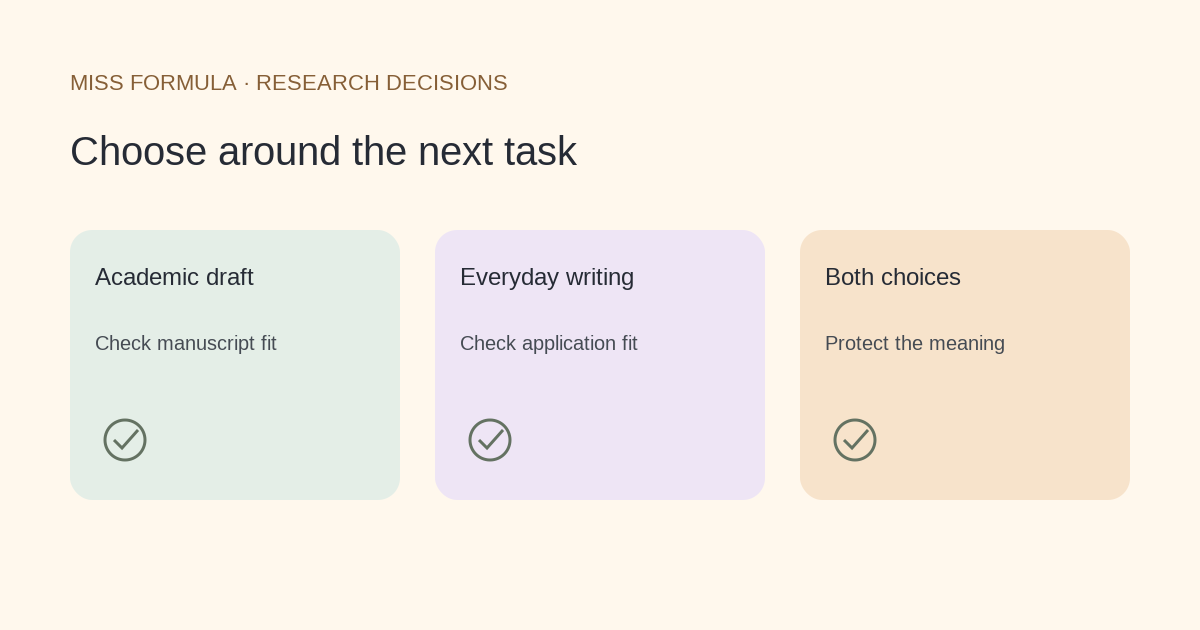
Choose around the document and the revision
Choose Paperpal when your main task is revising an academic manuscript and you want its research-oriented writing and submission-check workflow. Choose Grammarly when you need grammar, clarity, tone and rewriting support across your everyday writing surfaces. Keep the tool you already use if it handles your document and preserves the meaning of your revisions. Neither product can decide whether your scientific interpretation is justified.
| Decision | Paperpal | Grammarly |
|---|---|---|
| Documented emphasis | Academic writing, research and citation assistance, language and submission checks | Grammar, clarity, tone, rewriting and communication across applications |
| Revision task | Academic paraphrasing and reducing word count | Paragraph rewriting, proofreading and tone adjustment |
| Where to verify the fit | Your manuscript workflow and required submission checks | The application and supported writing surface you actually use |
| Scientific acceptance check | Compare methods, numbers, scope and citations before and after | Apply the same checks; fluent prose alone is insufficient |
| Access decision | Check current plan eligibility for the operations you need | Check current plan and application availability |
This is a task-based comparison from public documentation. It does not rank error rates or claim that one assistant always preserves technical meaning better. Read Paperpal’s product overview and Grammarly’s feature overview for the underlying capabilities.
When Paperpal belongs on the shortlist
Paperpal presents its workflow around academic manuscripts: language editing, paraphrasing, research and citation assistance, and pre-submission checks. That combination is relevant when the problem extends beyond correcting a sentence into preparing a scholarly draft. Verify that the particular check you need is available in the plan and interface you intend to use.
Do not treat academic positioning as proof that every suggestion is correct for your discipline. A plausible terminology change can alter a defined outcome, and a concise rewrite can omit an important limitation. Keep your source sentence and the paper or result it describes beside the edited version. For the content decision, the author remains responsible.
When Grammarly is the more useful fit
Grammarly documents proofreading, clarity and tone suggestions, paragraph rewrites and writing support across browser, desktop and other product surfaces. This can suit a researcher whose day includes manuscript prose, collaborator emails and explanations for a broader audience. Availability of specific AI actions varies by product surface; inspect the current support instructions before relying on a particular integration.
Its broader communication focus is not a reason to dismiss it for research writing. If your terminology and evidence are already settled, a grammar or clarity pass may be exactly what you need. Conversely, a general tone adjustment should not turn qualified evidence into an authoritative-sounding claim. See Grammarly’s generative assistance guide for supported surfaces and rewrite controls.
An original meaning-preservation trial
Use a small, fictional passage before processing a long abstract: “In 48 participants, the groups differed by 3 points at six weeks; the confidence interval included zero.” This is an editing fixture, not a real study. Ask each candidate tool to shorten the sentence without changing the population, numerical values, time point or uncertainty. Do not assume either tool produced the suggested answer below; it is an editorial example.
A possible shorter version is: “At six weeks, the 48 participants’ groups differed by 3 points, with a confidence interval including zero.” Whether you would accept that wording depends on the actual study design and surrounding sentence. A version that says “the treatment improved outcomes” fails this fixture because it adds an interpretation that the input does not establish.
| Protected fact | What to check |
|---|---|
| Population | 48 participants remains 48; no invented subgroup |
| Magnitude | 3 points remains a difference, not 3 percent |
| Time | Six weeks does not become six months |
| Uncertainty | The confidence-interval qualification remains |
| Attribution | Any real citation stays attached to the supported statement |
Apply a second test to a passage with a citation and a defined technical term. If the tool repeatedly changes either in your document, use narrower selections or revise manually. The fixture helps you assess the output you receive without pretending to be an accuracy benchmark.
Where Miss Formula fits in the same revision process
Miss Formula’s AI Writer offers a document workspace with selection-based rewriting and paragraph or full-document similarity workflows. It can be useful when you want to move from revision to reviewing overlapping text in the same workspace. It is not presented here as an equivalent to every Paperpal submission check or Grammarly integration.
For a specific operation, follow the abstract-shortening guide. For source-dependent passages, use uploaded-reference comparison and inspect the relevant source. A similarity result answers a different question from whether the revision preserves the findings.
Questions to answer before choosing
Which is more accurate? This article does not establish an accuracy winner. Test a representative passage against explicit checks. Should I buy both? Only if they solve different recurring tasks; start with the writing surfaces and operations you need. Does a clean grammar check mean publication readiness? No. Review evidence, methods, references, journal instructions and the final document. Should I switch during a submission deadline? Prefer a small copied passage first; do not move a complex manuscript without checking the handoff.
- Paperpal — academic research and writing workflow
- Grammarly — proofreading, clarity, tone and rewriting
- Grammarly — generative assistance by product surface
Official documentation checked November 24, 2026. Recommendations describe documented workflows; no comparative performance test was run.