JabRef vs Zotero for LaTeX Bibliographies
Choose by which file owns your bibliography, how citation keys survive edits, and whether your team also writes in Word. Includes a small migration acceptance test.
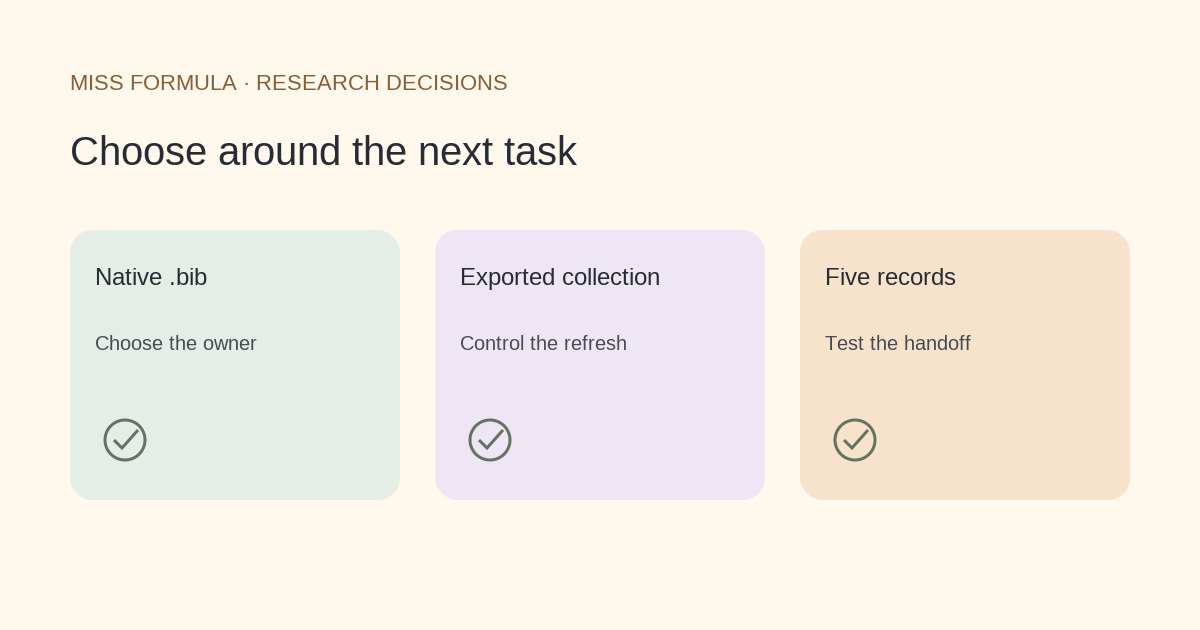
Choose the authoritative bibliography first
Choose JabRef when a BibTeX or biblatex file is the working library you want to inspect and maintain directly. Choose Zotero when a broader reference library and word-processor workflow matter, then decide how its LaTeX export will be maintained. Zotero with Better BibTeX is a third-party extension workflow, not a capability to attribute to an unmodified Zotero installation. This is a documented-workflow comparison, not a measured accuracy or speed ranking.
| Decision | JabRef | Zotero, with optional Better BibTeX |
|---|---|---|
| Working bibliography | Works directly with BibTeX/biblatex .bib files | Maintains library items; exports supply a .bib for LaTeX |
| LaTeX export maintenance | Save the working .bib library | Choose a deliberate export process; Better BibTeX adds automation |
| Other writing destinations | Check documented integrations for your editor | Bundled plugins support Word and LibreOffice; Google Docs integration is documented |
| Migration risk to inspect | Keys, entry types, fields and attachment paths | Keys, export settings, fields and attachment paths |
The practical question is who may change the master record. A coauthor editing an exported .bib while another person overwrites it from Zotero can lose corrections even when both applications work as designed.
What native BibTeX ownership changes
The JabRef format documentation states that the application works directly with BibTeX and biblatex rather than a separate internal library format. This fits a project where the bibliography is reviewed with the manuscript source. It does not mean that every imported field is scientifically correct or every entry already follows your journal style.
A direct-file workflow makes changes visible at the file level. Agree on a key convention before several people edit the same bibliography. Keep a backup before cleanup, and review changes to titles, capitalization protection, author names and entry types. These are proposed safeguards; they are not claims that JabRef changes or loses those fields.
JabRef also documents adding entries using identifiers. Identifier retrieval saves transcription work, but a valid DOI may still identify a different work from the one you meant. Open the source record and compare it with the paper.
When Zotero is the better home for the library
Zotero documents dynamic bibliographies in Word, LibreOffice and Google Docs. That matters for a team writing some papers in LaTeX and others in a word processor. Keeping one library can be more useful than making the .bib file the only shared asset.
The Better BibTeX maintainer documentation describes additional export formats, configurable citation keys and automatic export. Treat the extension and its settings as part of the research environment. Decide which collection is exported, where the file is written and whether collaborators can edit it directly.
Keep Zotero when its current library and writing integrations already meet your needs. Switching solely because a bibliography needs a few corrected records can cost more than fixing those records. Conversely, a team committed to a manually reviewed .bib may prefer to maintain that file directly. Neither choice guarantees better evidence.
Try five records before migrating a whole library
Use a copy of five real, permitted references: a journal article with a DOI, a book chapter, a preprint, an item with an accented author name, and an item with a title whose capitalization matters. This is a proposed acceptance test, not a test we have run against the products.
| Check | Pass condition |
|---|---|
| Keys | Existing citation commands still identify the intended entries |
| Metadata | Names, year, title and entry type survive the handoff |
| Version | Preprint and published article remain distinguishable |
| Files | An authorized coauthor can find any linked attachment |
| Build | The actual manuscript compiles and has no unexpected missing references |
Compile a small manuscript with your real bibliography processor and style. Then change one title in the authoritative library, repeat the export or save step, and verify that the correction reaches the bibliography. Record which file was overwritten. A successful export alone is not a successful authoring workflow.
Keep record verification separate from library management
Use Miss Formula AI Citation Checker to investigate reference identity and bibliographic mismatches, then make verified corrections in your chosen reference manager. It does not manage live Zotero citation fields or certify that the paper supports your claim. Read the metadata-mismatch guide and use the DOI checking workflow for a supplied identifier.
For a wider Word/Google Docs collaboration decision, see the existing Zotero versus Mendeley comparison. That is a different decision from choosing the owner of a LaTeX bibliography.
Questions before choosing
Is Better BibTeX part of Zotero itself? It is a separate extension maintained for Zotero; document it when relying on its export behavior.
Must every coauthor use the same manager? Agree first on the authoritative file, key policy and exchange format. A mixed setup still needs a tested handoff.
Will a reference manager validate my evidence? No. Bibliographic identity and whether a study supports a sentence require separate checks. Official documentation reviewed November 28, 2026; prices and storage allowances are excluded.