Connected Papers vs ResearchRabbit for Exploring Related Papers
Choose a visual discovery workflow by how you start, inspect relationships and save a defensible shortlist. A map helps find papers; it does not establish support for a claim.
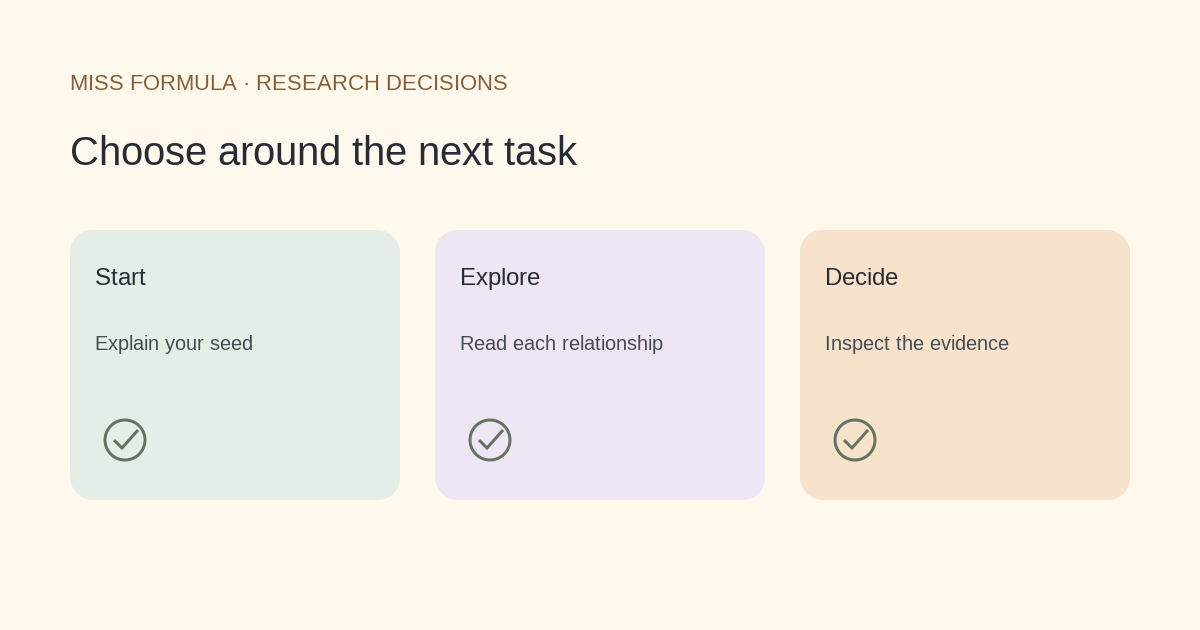
Choose by the exploration you need
Choose Connected Papers when you want to inspect a similarity neighborhood around a known paper. Consider ResearchRabbit when you want to grow a citation-based exploration from seed papers and keep selected results in collections. Neither map certifies that a paper supports a sentence in your draft. Read the original evidence before citing it. These recommendations concern documented workflows, not measured recall or research quality.
| Decision | Connected Papers | ResearchRabbit |
|---|---|---|
| Starting task | Explore papers similar to a known work | Add relevant seeds and grow a research map |
| Meaning of a relationship | Similarity can exist without a direct citation | Citation, shared-citation and authorship connections contribute |
| Next action | Inspect a promising neighbor and explore further | Change seeds or growth settings; save useful papers |
| Author responsibility | Read and record why a candidate belongs | Read and record why a candidate belongs |
Exact prices, current graph allowances and comparative database size are excluded because they do not answer this workflow question reliably. Check current account terms before committing a large review to either service.
Read the map before reading a ranking
The Connected Papers creator’s explanation describes a similarity graph based on co-citation and bibliographic coupling. Its historical launch description explains the underlying relationship; it is not evidence of today’s subscription limits. A nearby pair can be worth investigating even when the two papers do not cite each other.
ResearchRabbit’s current map documentation describes citations, shared citations and authorship links, and explains that changing seeds rebuilds the map. Its growth controls distinguish following references from following later citations. A network may favor established work; a prominent node is not automatically the most relevant study for a narrow population or intervention.
Start with a seed you can explain
A poor seed can make a convincing map of the wrong question. Before opening either tool, write a one-sentence inclusion rule and identify one paper that actually fits it. Here is a fictional planning exercise: include adult studies that measure sleep after a specified exercise intervention; exclude a paper that only mentions physical activity in its introduction. This is a proposed search exercise, not a claim that either service returned particular papers.
| Seed audit | Keep this note |
|---|---|
| Identity | Title, DOI or stable record and version |
| Reason | Population, exposure/intervention and measured outcome |
| Boundary | One related topic that should remain outside the review |
| Provenance | Date, service, seeds and settings used |
If you do not yet have a defensible seed, use a subject database or Miss Formula AI Source Finder to find candidates for a specific claim. It is a claim-to-source workflow, rather than a substitute implementation of either visual network.
Use a stopping rule for exploratory reading
Set a modest review budget before growing the map: for example, inspect ten candidates and explain why three merit full reading. The numbers are an illustrative personal time limit, not a recommended systematic-review sample. Record exclusions instead of saving every attractive node. After one round, ask whether the candidates actually sharpen the original question.
Stop expanding when the next neighborhood repeats the same methods or moves outside the inclusion rule. If an important subgroup is missing, revise the seed set or run a targeted database query. Do not infer that a study does not exist because it is absent from one map. A formal evidence review needs its own documented search and screening method; an exploratory graph alone is insufficient.
Move from discovery to a supported sentence
Keep three separate notes for every paper you may cite: its identity, why it fits your question, and the passage or result you have checked. A map supplies candidate relationships. It does not fill the evidence note. When you use Source Finder, inspect any available full-text excerpt alongside the original publication; an unavailable full text should remain an explicit gap.
For a time-bounded question, follow the Source Finder publication-year guide. Record the range and review returned years. A date filter can support a current-evidence search, while older foundational work may still belong in background reading. Do not silently combine differently bounded searches into a supposedly uniform set.
Questions before choosing a discovery map
Which tool finds every relevant paper? This comparison establishes no completeness claim. Coverage, seed choice and screening matter. Does a map edge mean agreement? No. A bibliographic or similarity relationship does not establish agreement with your claim. Should I move my whole library immediately? Start with a small collection and test identifiers, notes and export requirements first.
Official sources checked November 27, 2026: Connected Papers about page (current search excerpt; the direct page requires JavaScript), the creator explanation linked above, and ResearchRabbit’s current guide. The older creator article is used only for the stated conceptual explanation. No live head-to-head benchmark was performed. For a broader switch-away decision, see Semantic Scholar alternatives.